
Content

In the last decade, the cost of storing data dropped to almost nothing. Companies responded by saving everything—every click, every log, every transaction. They dumped it all into a “Data Lake” with the hope that it would be useful someday.
It didn’t work.
Instead of a clear lake, most organizations built a data swamp. The data is there, but it is unorganized, untrusted, and impossible to query. Analysts spend 80% of their time finding the right files and only 20% actually analyzing them.
The solution to this chaos is the medallion architecture.
This design pattern is the industry standard for organizing a modern Data Lakehouse. By structuring your data into three logical layers—Bronze (Raw), Silver (Validated), and Gold (Enriched)—you turn a messy swamp into a clean, efficient factory for business insights.
This guide explains what medallion architecture is, why modern platforms like Databricks and Azure rely on it, and how to implement it to fix your data quality issues permanently.
What Is Medallion Architecture?
The medallion architecture (sometimes called a “multi-hop” architecture) is a data design pattern. It is not specific software you buy; it is a way you organize the data you own.
The goal is simple: incrementally improve the quality of data as it flows through your system.
Think of it like a water filtration system. You don’t try to turn river water into drinking water in one giant, complicated step. You do it in stages. First, you remove the large debris. Then, you filter out the bacteria. Finally, you add minerals for taste.
In data terms, we take raw, messy inputs and pass them through three validation “hops” before they reach the dashboard. This makes sure that if an error occurs, we know exactly where it happened, and we can fix it without disrupting the entire company.
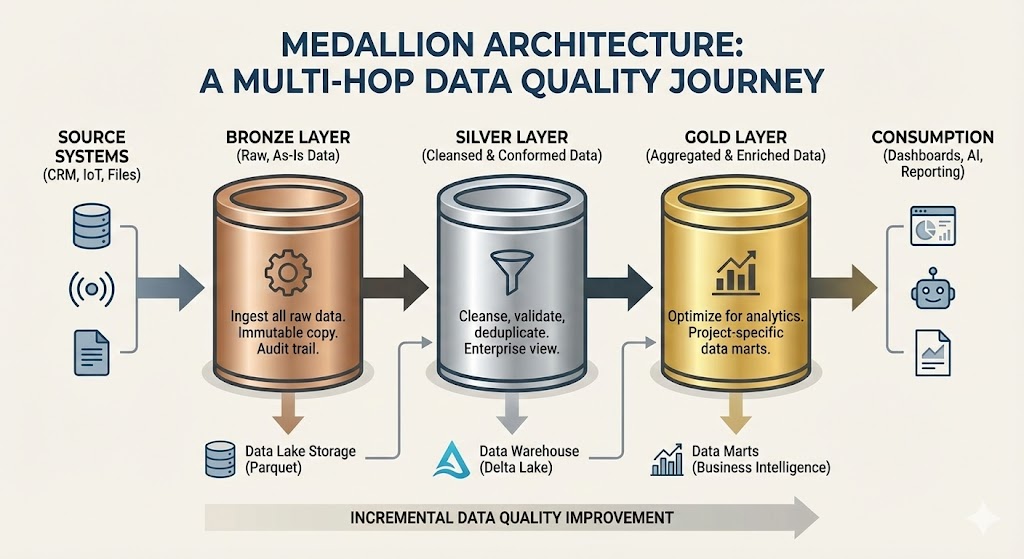
The Three Layers of Data Quality in a Medallion Architecture
Each layer in the architecture serves a distinct purpose for a different set of users. Understanding the specific role of each zone is the key to building a stable platform.
1. Bronze Layer (Raw Data)
The process begins in the Bronze data layer, often called the landing zone. The priority here is speed and preservation. We ingest data from external source systems (ERPs, CRMs, IoT) in its original “as-is” format.
We do not fix errors here. If the source system sends a typo, we keep the typo. This approach might seem counterintuitive, but it is essential for auditability. By maintaining an immutable copy of the raw history, you create a safety net. If business rules change in the future, you can replay your data processing from this original state.
Key activities in this layer include:
- Change Data Capture (CDC): Recording every insert, update, and delete from the source.
- Metadata Tagging: Adding technical details like load dates and source IDs to every file.
- Archiving: Storing data in efficient formats like Parquet or Delta for long-term retention.
2. Silver Layer (Cleansed & Conformed)
Once the raw data is secured, it moves to the Silver data layer. This is your refinery. Here, technical cleaning meets business integration. We filter out bad data, deduplicate records, and apply just enough transformation to make the data usable.
The primary goal of the Silver layer is to create an “Enterprise View.” Most companies have data silos—Marketing knows “Customer A” by their email, while Sales knows “Customer A” by their phone number. In the Silver layer, we merge these disconnected sources into a single, unified entity.
This is where trust is built. Data Scientists and Analysts use this layer to:
- Standardize Data: Converting different currencies, date formats, and codes into one common standard.
- Enforce Quality Rules: Removing records that lack mandatory fields or violate logic (e.g., negative sales amounts).
- Master Data Management: creating a Single Source of Truth for core business entities like Customers, Products, and Locations.
3. Gold Layer (Curated & Aggregated)
Finally, the refined data arrives in the Gold data layer. This is your showroom. While Silver is for analysts, Gold is for decision-makers. The data here is polished, aggregated into Key Performance Indicators (KPIs), and organized into specific “Data Marts” for each department.
The focus shifts from flexibility to performance. We restructure the data (often using Star Schemas) so that dashboards load instantly. This allows non-technical users to get answers without fighting with complex tables or writing SQL code.
In this consumption-ready layer, we:
- Apply Business Logic: Calculating metrics like Net Profit, Churn Rate, or Inventory Turnover directly in the database.
- Optimize for Reading: Using denormalization to reduce the number of joins required to answer a question.
- Tailor for Usage: Creating specific datasets for Sales, Finance, or HR, containing only the fields they actually need.
Not sure where to start with your Data Architecture?
Don’t guess. We identify your current gaps and provides a clear roadmap to a modern, Medallion-based architecture on Azure or Databricks.
Get a clear roadmap for your data.

Get a clear roadmap for your data.
Why Modern Enterprises Are Moving to the Lakehouse
For a long time, companies had to choose between two imperfect options. You could have a Data Warehouse (structured, trusted, but expensive and rigid) or a Data Lake (cheap, flexible, but messy).
The Medallion Architecture enables a new model: the Lakehouse.
Supported by platforms like Databricks and Microsoft Azure, this approach gives you the best of both worlds. You get the low-cost storage of a Data Lake (in the Bronze layer) with the structure and reliability of a Data Warehouse (in the Gold layer).
Specifically, a Databricks medallion architecture introduces features like “ACID transactions” to the data lake. This means complex data updates happen safely—data is never lost or corrupted halfway through a process. This reliability was missing from early data lakes and is the main reason large enterprises are migrating to this standard today. It allows you to run traditional BI reports and advanced Machine Learning models on the same platform, without moving data around.
The Consultant’s Angle – Where Do Implementations Fail?
We have helped many organizations migrate to this architecture. While the concept is simple, the execution requires discipline. The most common failure we see is skipping layers.
Some teams try to go straight from Bronze to Gold to save time. They take raw data and try to build a report immediately. The result is always the same: the report breaks whenever the source system changes, and the logic becomes a tangled mess of “spaghetti code” that no one can debug.
Other teams make the mistake of over-cleaning the Bronze layer, deleting historical data they “think” they don’t need, only to regret it six months later when they need to audit a transaction.
Success comes from respecting the boundaries. Let Bronze be raw. Let Silver be clean. Let Gold be business-ready.
Our Data Consulting Services You Might Find Interesting


Build Your Modern Data Stack with Multishoring
Moving to a Medallion Architecture is not just a technical upgrade; it is a strategic shift. It changes how your company treats its most valuable asset.
At Multishoring, we specialize in Modern Data Architecture Services. Whether you are building a new Lakehouse from scratch on Azure or cleaning up an existing Data Swamp in Databricks, our engineers can guide you.
We often start with a Data & Analytics Maturity Assessment. We look at your current setup, identify the bottlenecks, and map out a clear path to a structured, high-performance data environment.
Stop guessing with your data. Contact Multishoring today to assess your architecture and start building a foundation you can trust.