
Content

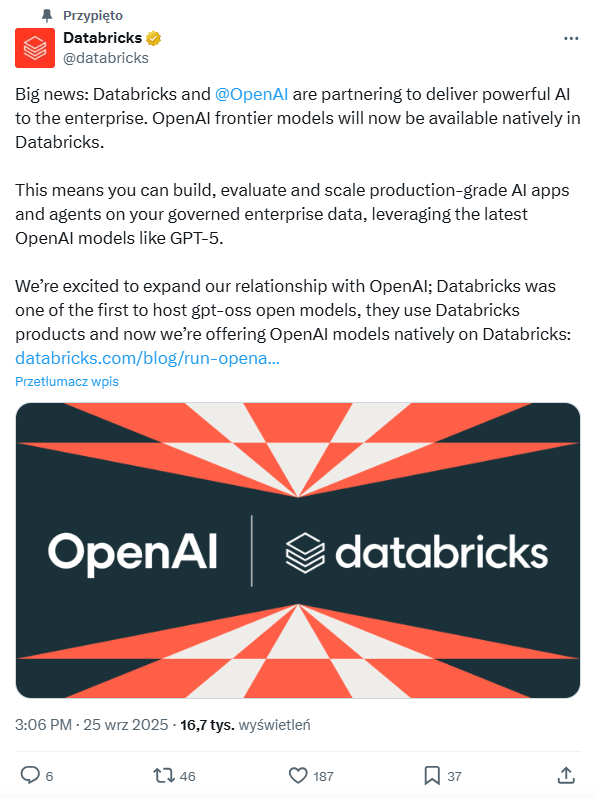
The enterprise AI and data world was stirred today as Databricks and OpenAI announced a landmark partnership. The news, which broke via a tweet from the official Databricks account and a YouTube video announcement, details a $100M+ multi-year collaboration designed to make OpenAI’s most advanced “frontier models,” including the highly anticipated GPT-5, directly available within the Databricks platform.
This strategic alliance is set to remove one of the biggest hurdles for AI adoption in large companies: using cutting-edge models on sensitive, proprietary data without compromising security or governance.
A Strategic Alliance to Bridge the Enterprise AI Gap
For many organizations, the primary challenge in deploying generative AI has been the separation between powerful third-party models and their own internal data. This partnership aims to eliminate that gap.
The integration means that over 20,000 Databricks customers will be able to run and fine-tune OpenAI models where their enterprise data already lives, requiring no extra setup or data movement.
The core promise is to allow businesses to build, evaluate, and scale production-grade AI applications and agents on their own governed information. This provides the security and control that critical business workloads demand while granting access to the state-of-the-art reasoning and instruction-following capabilities of models like GPT-5.
How the Native Databricks & GPT Integration Works
The partnership goes beyond simple API access. OpenAI models will be natively integrated into the Databricks ecosystem, allowing users to:
- Run Models Directly on Data: Users can call models like GPT-5 from within SQL queries or as API endpoints through Databricks Model Serving.
- Build and Scale Smarter Agents: The integration is designed to work seamlessly with Agent Bricks, Databricks’ unified product suite for developing and deploying AI agents that can reason on enterprise data and perform complex, domain-specific tasks.
This allows organizations to develop sophisticated agents for everything from financial risk analysis and healthcare decision support to modernizing legacy code and improving customer support.
Industry Leaders Welcome the Collaboration
The announcement was met with enthusiasm from industry leaders who see the potential to accelerate their own AI initiatives.
“For any use case, AI agents come down to three things: quality, scale, and trust,” said Greg Ulrich, Chief AI and Data Officer at Mastercard. “This partnership between Databricks and OpenAI enables us to build trusted AI agents that harness the latest OpenAI models, delivered with the speed, security and scale of the Databricks platform.”
Connie Cheung, VP of Engineering at Experian, echoed the sentiment, stating, “The partnership… is an exciting step forward, enabling us to build, evaluate and deploy trusted AI applications on our data with Databricks while tapping into the latest OpenAI models.”
The Path Forward – Data Driven With Better AI
This launch marks the beginning of a deep engineering collaboration between the two companies. In addition to GPT-5, smaller variants like GPT-5 mini and GPT-5 nano will also be made available.
Organizations interested in trying the new capabilities can get access to the Public Preview by contacting their Databricks account team. To further detail their shared vision, the companies announced a virtual event, “The Future of AI: Build Agents that Work,” which will feature a conversation between OpenAI CEO Sam Altman and Databricks CEO Ali Ghodsi.
Our Data Consulting Services You Might Find Interesting